

Correct Score Betting
Correct score betting is picking the exact final score of a match — not just who wins, but the precise goal tally, like 1-0 or 2-1. Both halves of that have to land: the right winner and the right number of goals. That double demand is why a single 1-0 can pay around 7.00 while a plain home win pays 1.90. It’s the market with the biggest prices and the smallest hit-rate on the soccer board.
Why the odds are so long
A soccer match has dozens of realistic scorelines, and your stake sits on exactly one of them. Even the most frequent result in football — the humble 1-0 — only occurs in roughly one in ten matches across the run of a season. Spread the probability across 0-0, 1-0, 2-0, 2-1, 1-1 and the long tail of 3-2s and 4-1s, and no single score carries much chance. The bookmaker prices each one accordingly and tucks a margin into the whole grid.
That’s the honest framing: you’re not getting 7.00 on a 1-0 because the book is generous. You’re getting it because a 1-0 genuinely doesn’t happen often.
How books price the common scores
The low, tight scores bunch at the front of the market because they happen most. Here’s the rough shape of where the common scorelines sit in a fairly even fixture:
| Score | Typical price | Why |
|---|---|---|
| 1-0 / 0-1 | ~7.00 | The single most common winning margin |
| 2-1 / 1-2 | ~8.50 | Common but needs three goals to fall right |
| 1-1 | ~6.50 | The most likely draw, so often the shortest score |
| 0-0 | ~9.00 | Frequent in tight games but easy to break |
| 2-0 / 0-2 | ~9.50 | Comfortable wins, less common than a 1-0 |
Anything past three goals drifts out fast — a 3-2 is a fun-looking 30.00-plus precisely because it’s rare. Prices move with the matchup: two attacking sides shorten the high scores, two defensive ones shorten 1-0 and 0-0.
When a correct-score bet is actually worth it
This isn’t a market you grind for value across a card. It pays off when you have a specific structural read, not a hunch:
- A tight, low-scoring grind. Two defensive sides, a cagey cup tie, nothing to play for — 1-0 and 0-0 carry real chance and a real price.
- A heavy mismatch with a likely scoreline. A dominant side that controls without running riot often lands a clean 2-0 or 2-1.
- Weather or a flat pitch that suppresses goals nudges you toward the low scores.
A worked example: you fancy a defensive home side to edge a poor visitor. You back 1-0 at 7.00 with R50. It lands — R350 back, R300 profit. The reality check: you’ll lose that exact bet far more often than you win it, so it only makes sense at a stake you’re happy to lose four times before it pays once.
Scorecast: one step further out
A scorecast bolts a goalscorer onto the correct score — say, 2-1 and Player X to score first. The price balloons because you’re now stacking three correct calls into one bet: the exact score, the right scorer, and the order. It’s the same trade as correct score, only with a thinner strike-rate and a fatter payout. Treat it as a small-stake long shot, never a strategy — read more on the goalscorer side in anytime goalscorer betting.
Correct score is a read-the-game market, not a winner-picking one. If you just want the result without the goal-count gamble, 1X2 betting is the simpler play. You’ll find these markets live at Scorebet, and you can compare the rest in the the rest of the soccer markets.
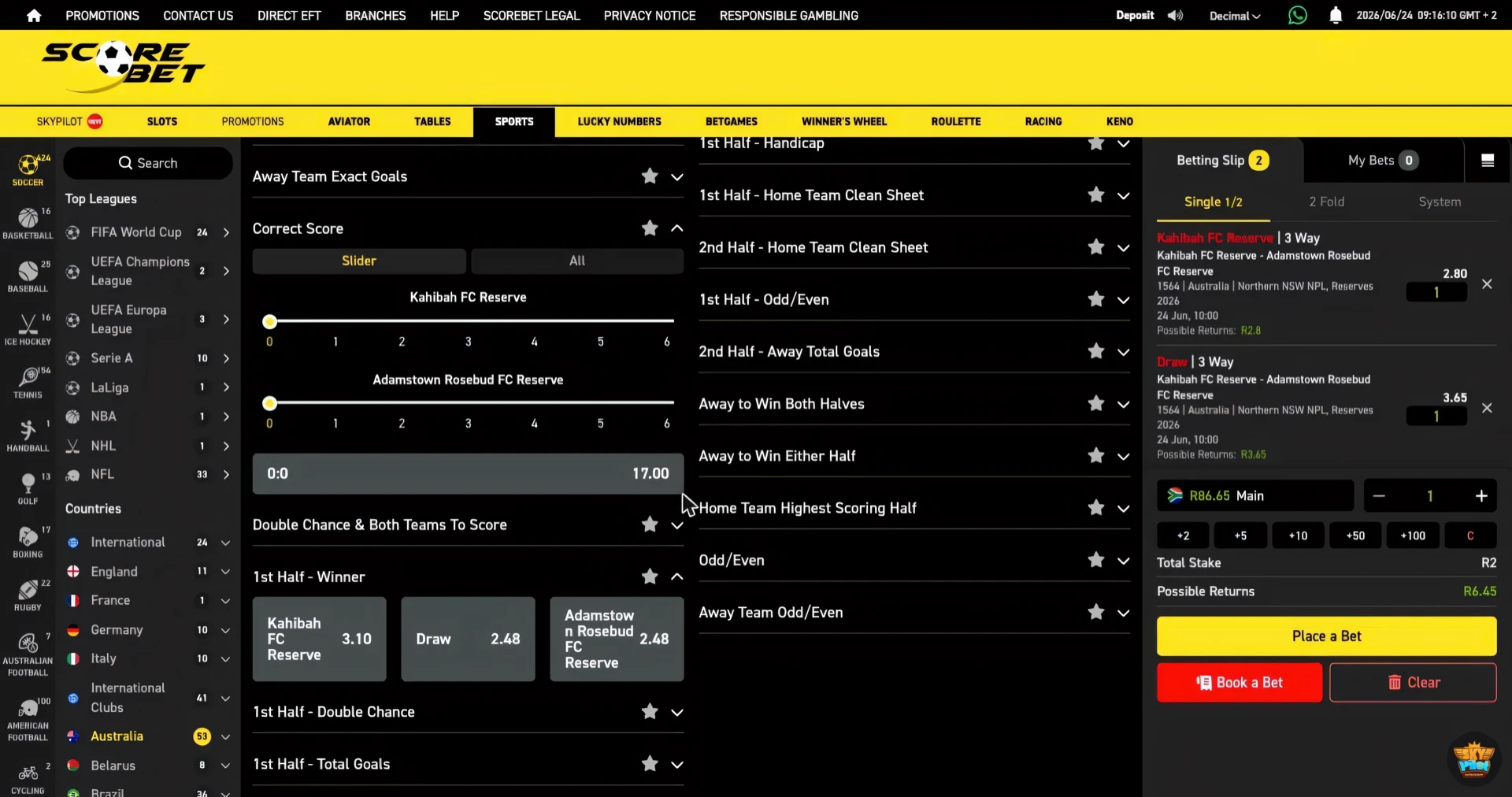
Place it on Scorebet, step by step
- 1Find the Correct Score section
Open a match and scroll to the Correct Score section to see the slider interface.
- 2Set the home and away goals
Drag the Home Team slider to the goals you expect them to score, then the Away Team slider for the away side. Switch to All to see every score at once.
- 3Add the score to your slip
The odds for that exact score (for example 1:0 — 5.50) appear. Tap the button to add it to your Betting Slip.
- 4Stake and place
Enter your stake and tap Place a Bet.
Example: Correct Score odds
| Score | Odds | R10 returns |
|---|---|---|
| 0:0 | 17.00 | R170.00 |
| 1:0 | 5.50 | R55.00 |
| 1:1 | 6.00 | R60.00 |
| 2:1 | 8.00 | R80.00 |
| 3:0 | 15.00 | R150.00 |
The most common scores in football are 1:0, 1:1 and 2:1. A 0:0 at 17.00 offers big returns if you expect a tight, low-scoring match.
High risk, high reward. Correct Score bets are low probability but very rewarding — consider small stakes for big potential returns.
Frequently asked
What does correct score mean in betting?
You're betting on the exact final score of the match — 1-0, 2-1, 0-0 and so on. Both the result and the precise number of goals each side scores have to be right. Get the winner correct but the score wrong and the bet loses.
Why are correct score odds so high?
Because there are dozens of plausible scorelines and your money is on exactly one. Even the most common result, 1-0, only happens in a fraction of matches, so the bookmaker can price it around 7.00 and still hold a margin.
Is correct score a good bet?
It's a low-strike-rate market — you'll lose most of them. It only earns its place when you have a specific read on the game's shape, like a low-scoring grind between two defensive sides, not as a regular punt.
What scoreline does a correct-score bet settle on if the match goes to extra time in a cup tie?
Correct score, like 1X2, settles on the 90-minute result plus stoppage time only — extra time and penalties are ignored. So a tie that's 1-1 after 90 and won in extra time settles your correct-score bet as 1-1, not the final aggregate. Plenty of punters get burned assuming the extra-time goals count.
Why is the most likely draw, 1-1, often shorter than 0-0 even in defensive games?
A 0-0 needs both attacks to misfire completely, which is rarer than each side managing a single goal, so 1-1 carries more probability and prices shorter across most fixtures. The book reflects that with 1-1 usually the shortest score on the grid in an even match. Only in genuinely stifled, low-chance games does 0-0 close the gap on it.