

Both Teams to Score
Both Teams to Score (BTTS) is a Yes/No bet on whether each side scores at least one goal. Yes wins if both teams find the net; No wins if either side is kept off the scoresheet. Who wins the match is irrelevant — a 1-1 and a 3-2 both settle BTTS as Yes, while a 4-0 settles as No.
Why punters like it
BTTS is popular because it’s independent of the result. You don’t need to call the winner, which is the hardest part of soccer betting — you only need a read on whether goals will be shared. That makes it useful when you fancy an open, end-to-end game but have no strong view on which side comes out ahead. It also keeps a bet alive deep into a match: a single goal each settles Yes regardless of what happens next.
A worked example in rand
Say BTTS is priced like this:
| Selection | Meaning | Odds |
|---|---|---|
| Yes | Both teams score | 1.72 |
| No | At least one team blanks | 2.00 |
You stake R150 on Yes at 1.72. If both sides score — say the game finishes 2-1 — you get back R258 (R150 stake plus R108 profit). If it ends 1-0, 0-0 or any scoreline with a clean sheet, the R150 is lost. The two prices reflect that, across a full season of fixtures, both teams score in a little under half of matches.
Reading the match for Yes or No
Lean towards Yes when both sides attack and at least one defends poorly: high-scoring teams, leaky back lines, two sides that need a result and will push forward. Lean towards No in cagey games — a derby where both sides fear losing, a team that defends deep and soaks pressure, or a heavy favourite likely to win comfortably while the underdog rarely threatens. A strong goalkeeper or a settled defence shifts the read towards No.
If you care about the total number of goals rather than whether both teams contribute, the over/under goals market is the closer fit — a 3-0 misses BTTS but sails over a 2.5 line. Keep stakes sensible, and use the responsible-gambling tools if a session stops being fun.
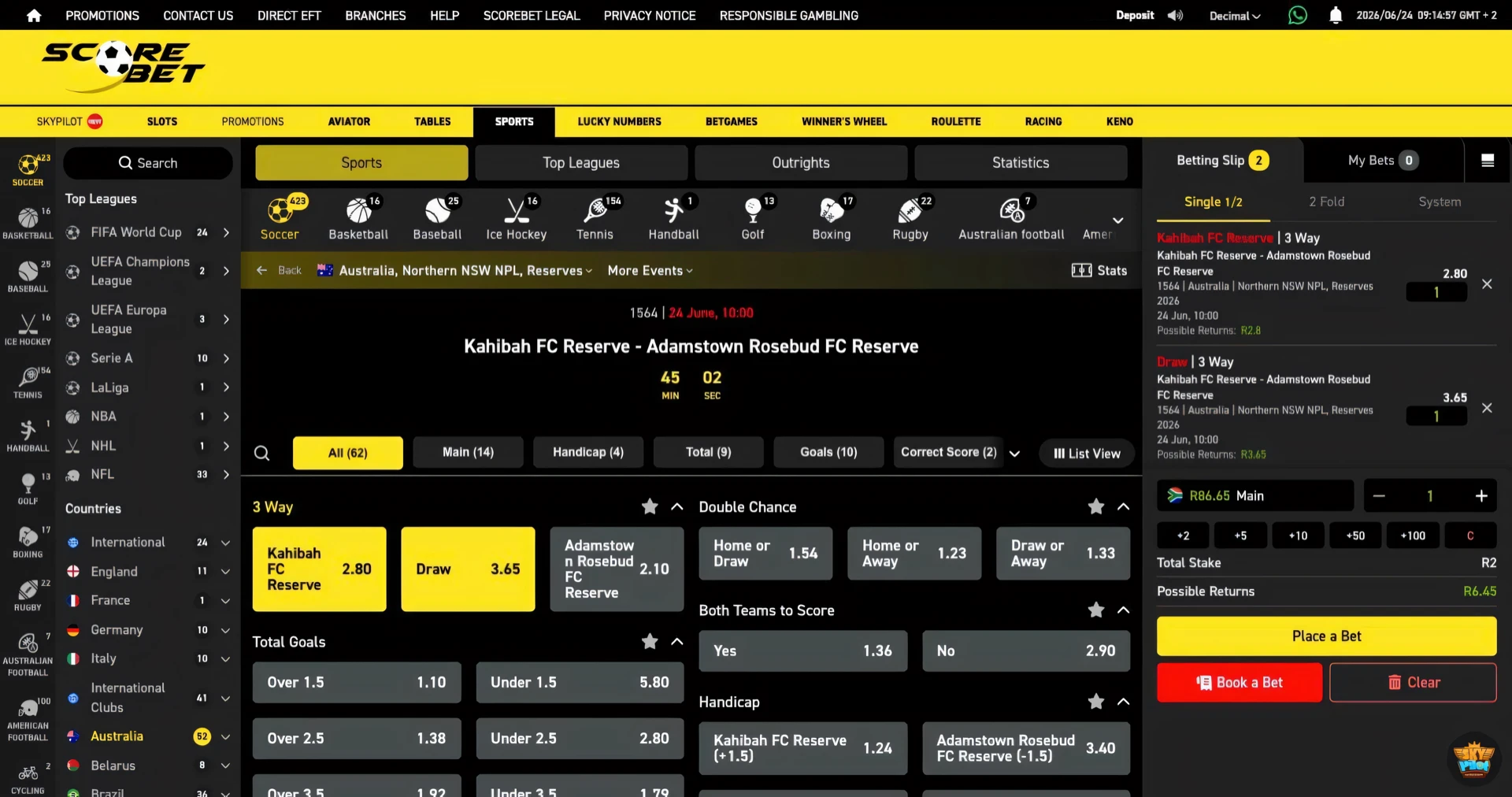
Place it on Scorebet, step by step
- 1Open a football match
Go to SPORTS and open a fixture, then find the Both Teams to Score section on the markets page.
- 2Choose Yes or No
Tap Yes if you think both sides will score, or No if you expect at least one to be kept goalless. The button turns yellow.
- 3Stake and place
Enter your stake in the Betting Slip and tap Place a Bet.
Example: BTTS odds
| Selection | Odds | R10 returns | Wins if |
|---|---|---|---|
| BTTS Yes | 1.36 | R13.60 | Both teams score at least once |
| BTTS No | 2.90 | R29.00 | At least one team is kept goalless |
BTTS is independent of the result — a 1-1 draw and a 3-2 win both settle Yes. Handy when you expect an open game but can't call the winner.
Frequently asked
What does both teams to score mean?
It's a bet on whether each side scores at least one goal in the match. BTTS Yes wins if both teams find the net; BTTS No wins if at least one team is kept off the scoresheet. The final result doesn't matter.
What is GG and NG in betting?
GG (goal-goal) is the same as BTTS Yes — both teams score. NG (no-goal) is BTTS No — at least one side fails to score. They're just older labels for the same market on some bet slips.
Does a 0-0 count as both teams to score?
No. A 0-0 settles BTTS as No, because neither side scored. Any scoreline where one team is kept to zero — 1-0, 3-0, 2-0 — is also a No. You need both teams on the scoresheet, like 1-1 or 2-1, for Yes to win.
Does an own goal count towards both teams to score?
Yes — an own goal is credited to the team that benefits, so it counts towards their tally for BTTS purposes. If the only goal a side 'scores' is bundled in by an opponent, that still settles their half of a Yes. It's a quirk that's saved plenty of BTTS Yes slips that looked dead.
Why is BTTS Yes often shorter than the raw goal rate suggests?
Both-teams-to-score lands in a bit under half of matches across a full season, yet Yes is frequently the shorter price because punters love backing goals and the book leans into that demand. You're often paying a premium for the popular side of the bet. When you genuinely fancy a tight, low-scoring game, the No can be the better-value half precisely because fewer people want it.