

Rugby Winning Margin
Winning margin is the market that rewards a precise read. Instead of just backing a side to win, you call the band their margin lands in — Scorebet runs 1–7, 8–14 and 15+ points for each team, plus a Draw. Rugby’s varied scoring (a converted try is seven, a penalty three) means margins cluster in readable ranges, and pricing each band separately turns “they’ll win comfortably” into a genuine bet.
It’s effectively a sharper, higher-paying handicap: rather than one line to beat, you’re pinning the size of the win. The reward for that precision is generous odds — a correct mid-band call can pay 3.00–7.00 — but the margin for error is a single score. Back a side at 8–14 and a late try that pushes the win to 15 turns a winner into a loser.
Use it when you have a real view on how big, not just who. A Springbok side grinding out a tight one against a quality opponent points to the low band; a mismatch against a struggling team points to 15+. Pair it with a read on tempo from total points and you’ve got the whole shape of the game covered.
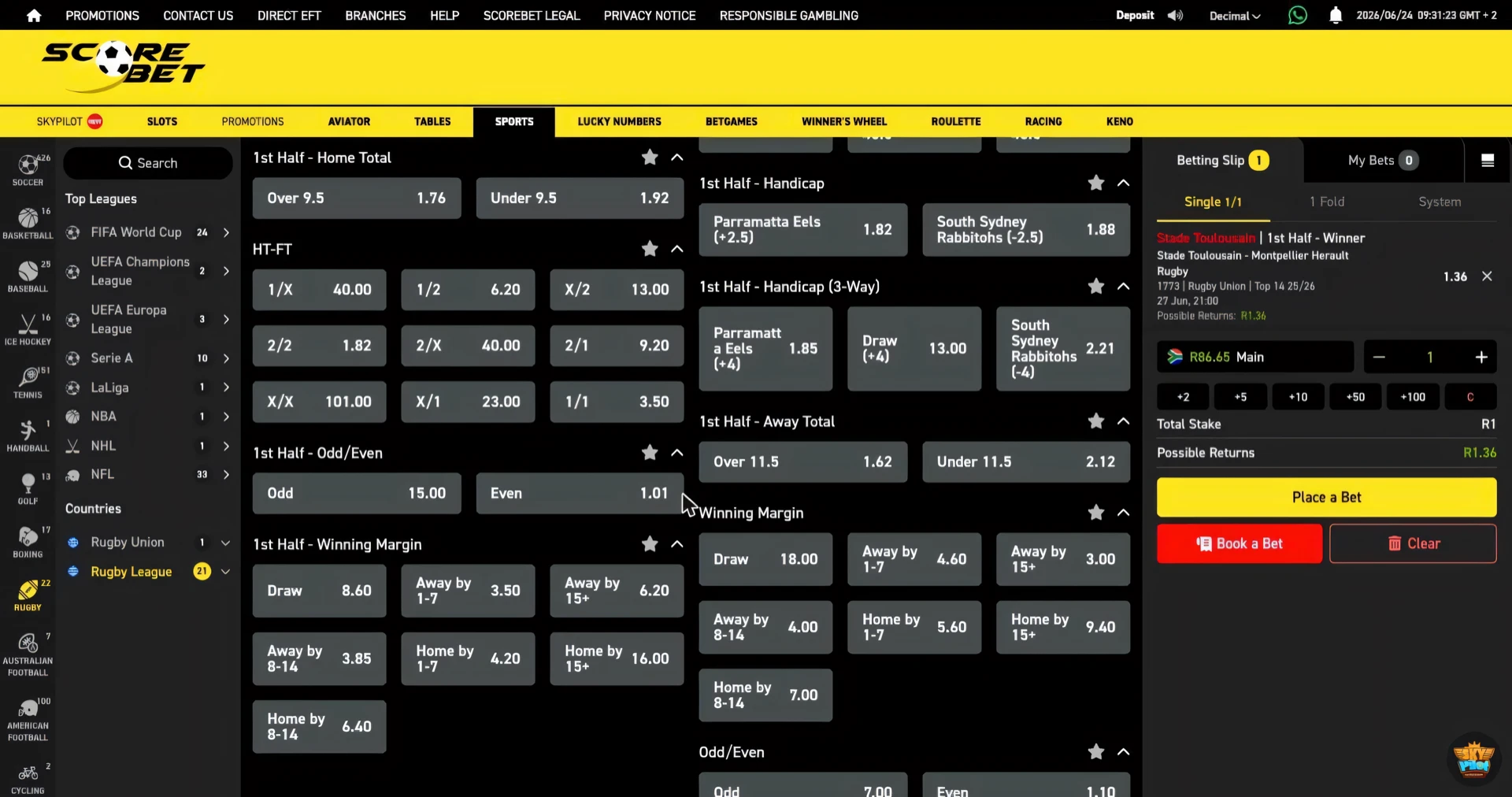
Place it on Scorebet, step by step
- 1Open the match and find Winning Margin
Open a rugby fixture on Scorebet and scroll to the Winning Margin section.
- 2Pick the team and the band
Choose which side you expect to win and by how much — 1–7, 8–14 or 15+ points.
- 3Stake and place
Tap the odds button, enter your stake and tap Place a Bet.
Example winning margin odds (NRL)
| Outcome | Odds | R10 returns |
|---|---|---|
| Draw | 18.00 | R180.00 |
| Away by 1–7 | 4.60 | R46.00 |
| Away by 8–14 | 4.00 | R40.00 |
| Away by 15+ | 3.10 | R31.00 |
| Home by 1–7 | 5.60 | R56.00 |
| Home by 8–14 | 7.00 | R70.00 |
| Home by 15+ | 9.40 | R94.00 |
A one-score game (1–7) tends to happen between evenly-matched or defensive sides; a 15+ blowout is common when a top side meets a struggler. Weigh season form before you pick the band.
Get the band wrong by a single converted try and it's a loss — that risk is exactly why the price is so much bigger than a straight win.
Frequently asked
How do winning margin bands work in rugby?
You pick a team and the band their winning margin falls in — typically 1–7, 8–14 and 15+ points, plus a Draw option. Get the team and the band right and it pays; miss the band by a single score and it loses, which is why it pays more than a straight win.
Is winning margin better than the handicap?
It's sharper and higher-paying. A handicap is one line to beat; winning margin asks you to call the exact size of the win. Use it when you have a genuine read on how big a win will be, not just who wins.
Why does the favourite's biggest margin band not always carry the shortest price?
The price reflects how the expected score is distributed, not just who is favoured. If a side is tipped to win by around 10, the 8–14 band can be shorter than the 15+ band even though 15+ is the 'bigger' win, because the model thinks the result is more likely to land in that middle range. Read the band prices as the bookmaker's map of the most probable margins, and pick the one your own read agrees with.
How does buying a margin band compare with backing a team on the handicap?
A handicap pays as long as you clear one line, so a +3 cushion of error still wins; a margin band has a ceiling as well as a floor, so a result that is too big loses just as surely as one too small. That two-sided risk is exactly why a margin band pays several times the handicap price. If you are confident a side wins but unsure how heavily, the handicap is safer; only reach for the band when you genuinely fancy the size of the win.