

Rugby Handicap
The handicap is where most serious rugby betting happens. Because mismatches are so common, the straight match result on a heavy favourite is too short to be worth a stake — so Scorebet hands the favourite a points disadvantage and the underdog a points start, and you bet on the line instead of the raw result.
Back the favourite at -9.5 and they must win by 10 or more to pay; back the underdog at +9.5 and they’re covered if they win outright or lose by nine or fewer. Scorebet runs two flavours: the 2-way (Asian) line with a half-point, where there’s no draw, and the 3-way line on a whole number, which adds a Draw outcome for when the adjusted scores tie.
The whole craft is reading the true gap against the line — a read where your local knowledge of Springbok rotation, derby intensity and bench strength beats a global pricing model. When you want to call the size of a win rather than just beat a line, step across to winning margin.
Place it on Scorebet, step by step
- 1Open the match and find Handicap
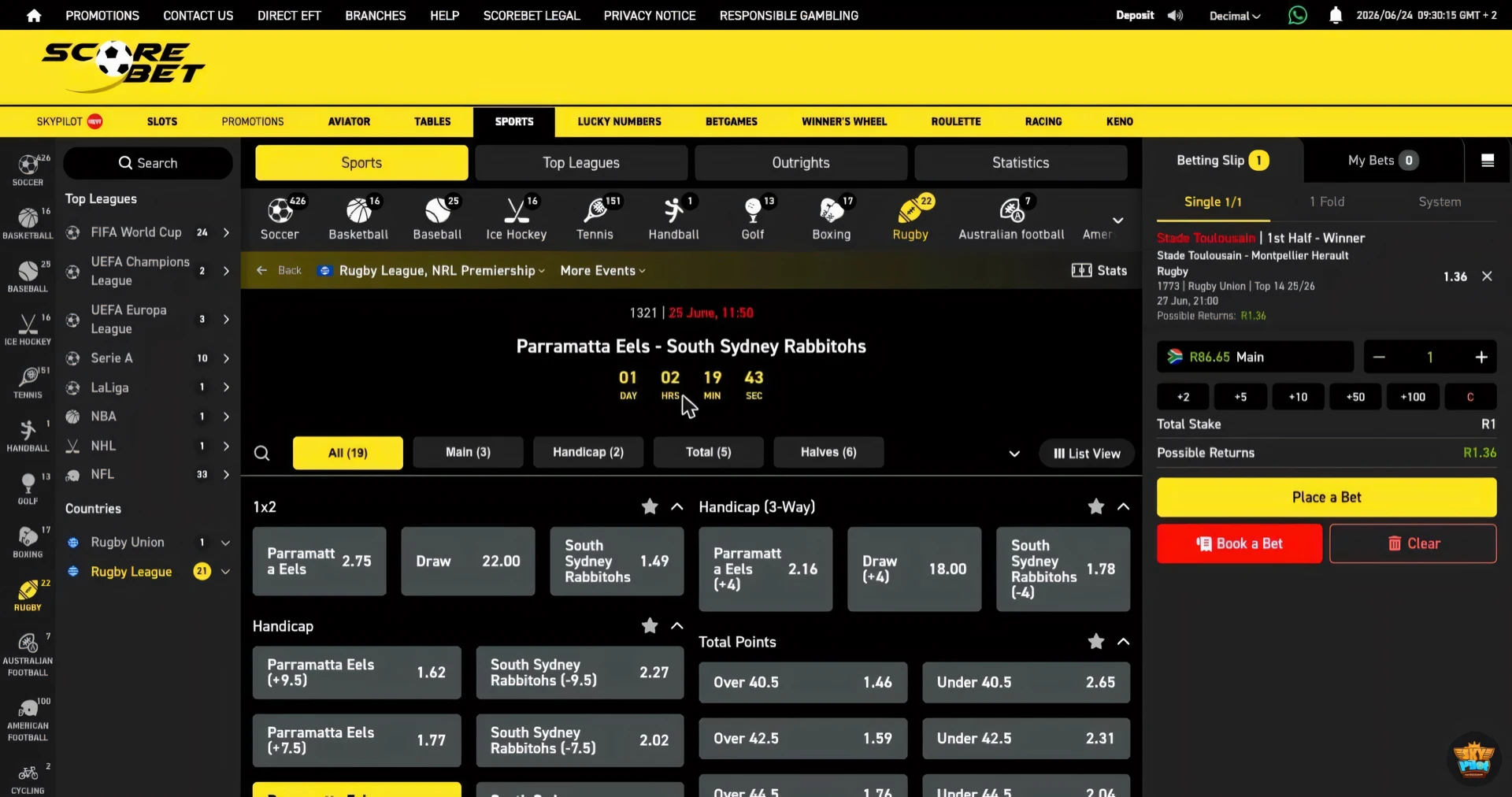
Open a rugby fixture on Scorebet and scroll to the Handicap section. You'll see both a 2-way and a 3-way version.
- 2Pick your line and team
Several lines are shown (e.g. +9.5, +7.5, +5.5, +3.5). Choose the team and the points start you want.
- 3Stake and place
Tap the odds button — it turns yellow — then enter your stake and tap Place a Bet.
Example: Asian (2-way) handicap
| Selection | Odds | Wins if… |
|---|---|---|
| Parramatta Eels (+9.5) | 1.62 | Eels win, or lose by 9 or fewer |
| South Sydney Rabbitohs (-9.5) | 2.27 | Rabbitohs win by 10 or more |
| Parramatta Eels (+4) — 3-way | 2.16 | Adjusted score favours the Eels |
| Draw (+4) — 3-way | 18.00 | Adjusted score is exactly level |
Reading the line: the bigger the spread, the more dominance the bookmaker expects. Taking the underdog with a large points start is the safer side of a clear mismatch.
The skill isn't picking the winner — it's judging whether the real gap is bigger or smaller than the line. A favourite resting players in a dead rubber often wins but fails to cover.
Frequently asked
What is the difference between 2-way and 3-way handicap in rugby?
A 2-way (Asian) handicap uses a half-point line like +9.5, so there's no draw — you either win or lose the bet. A 3-way handicap uses a whole number like +4, which adds a Draw option for when the adjusted scores finish exactly level.
How big are rugby handicap lines?
Much bigger than football. Because rugby scores run to 20–40+ points, lines commonly sit between 2.5 and 23.5 points, and the wider the line the more the bookmaker expects one side to dominate.
Why do rugby handicaps cluster around multiples of seven?
A converted try is worth seven, so wins tend to land in seven-point steps — 7, 14, 21 — and the bookmaker sets the favourite's line just under the score it expects them to win by. A line at -13.5 quietly assumes a two-converted-try margin, and -6.5 assumes a single one. Reading the line as 'how many converted tries clear' is often a cleaner way to judge whether it is beatable than thinking in raw points.
Does taking the underdog on the handicap protect me if they win outright?
Yes — a points start covers both ways. Back the underdog at +9.5 and you win whether they lose by nine or fewer or win the match outright, because their handicap-adjusted score is even higher in that case. That is the quiet advantage of the plus side: you are not just betting on a brave defeat, you are also still paid if they pull off the upset. The only losing outcome is the favourite winning by 10 or more.