

To Win a Set
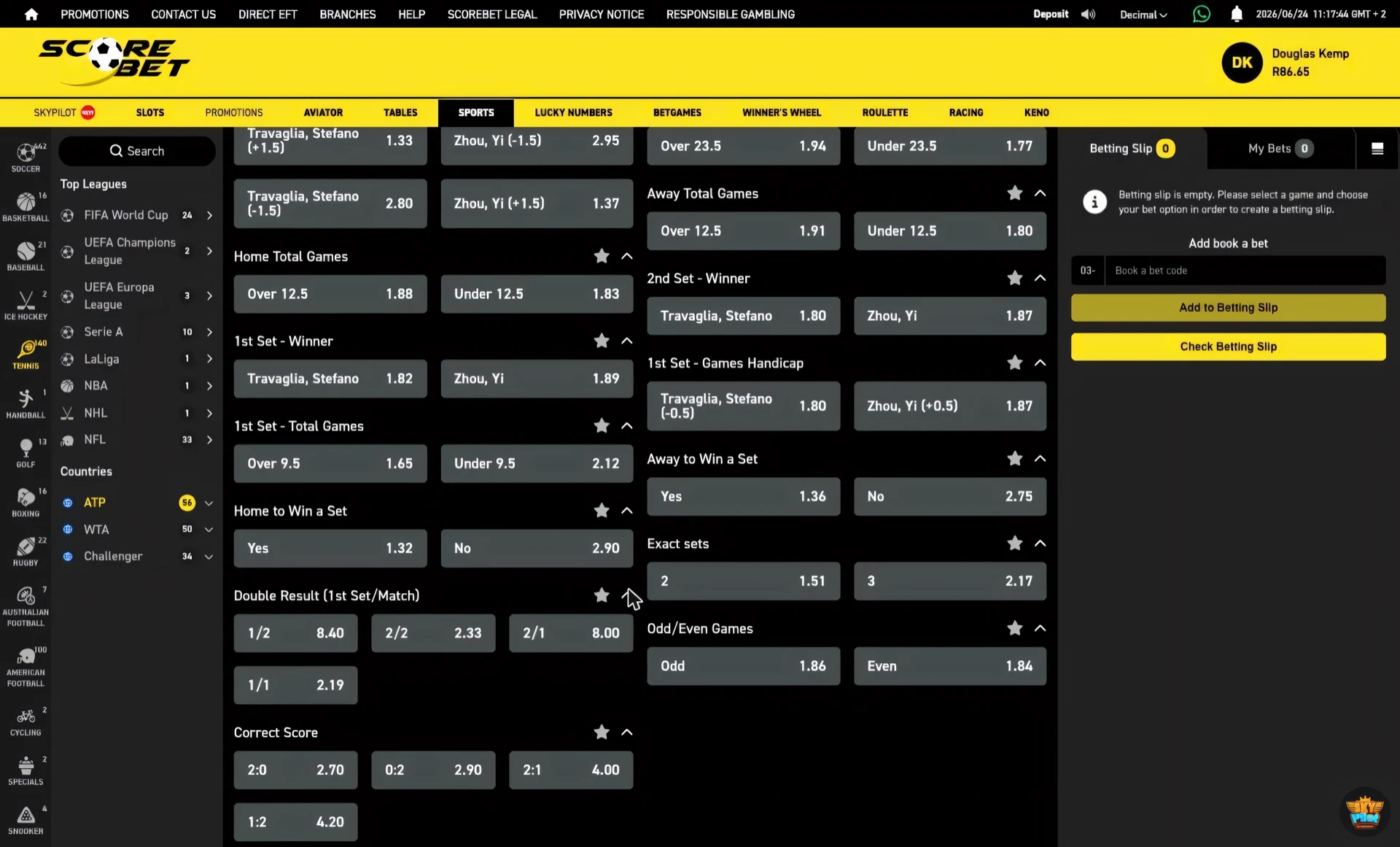
To win a set is the tidiest underdog bet in tennis: forget the match result, just ask whether a player takes at least one set. Back Yes and any set they win pays; back No and you need them swept. On Scorebet it sits as a clean Yes or No on each player, separate from the match winner.
The market shines when there’s a class gap. A favourite expected to win comfortably might still drop a set on serve or in a tie-break, so the underdog’s Yes at a short price can be a reliable banker. Flip it round and the No — betting that the underdog gets swept — pays a healthy price when a top player faces a clear journeyman, because a straight-sets blanking is harder to land than the match price suggests.
If you’d rather call which set is won, the set winner market prices each set individually. And if you want to nail the exact set tally, step up to correct score, where backing a sweep pays a longer price for the extra precision.
Place it on Scorebet, step by step
- 1Open the match and find the section
Open a tennis fixture and scroll to Home to Win a Set or Away to Win a Set.
- 2Back Yes for at least one set
Tap Yes if you believe that player will take at least one set in the match.
- 3Back No for a sweep
Tap No if you expect that player to be swept, for example 2-0 in sets.
- 4Stake and place
Add the pick to your Betting Slip, set your stake, then tap Place a Bet.
Example: to win a set prices
| Selection | Odds | R100 returns | Wins if… |
|---|---|---|---|
| Home (Travaglia) to Win a Set — Yes | 1.32 | R132.00 | Travaglia takes any set |
| Home — No | 2.90 | R290.00 | Travaglia is swept |
| Away (Zhou) to Win a Set — Yes | 1.36 | R136.00 | Zhou takes any set |
| Away — No | 2.75 | R275.00 | Zhou is swept |
No bets pay well because a clean sweep is rarer than it looks. They're useful when a top-five player faces a journeyman who can still nick a set.
A heavy underdog who can hold serve is a live Yes — one tight set on serve and a tie-break is all it takes, even in a match they go on to lose.
Frequently asked
What does to win a set mean in tennis?
It asks whether a chosen player wins at least one set in the match. Back Yes and you collect if they take any set; back No and you collect only if they're swept, for example 2-0 in a best-of-three.
When is a No bet on to win a set good value?
When a top player faces a journeyman, a straight-sets sweep is likely, so the No on the underdog can pay a healthy price. It's a clean way to back dominance without needing the exact score.
Why does a best-of-five Slam make a No bet harder to land than the same match on the tour?
In best-of-three the favourite only needs to win two sets to sweep, but at a men's Slam they have to take three clean sets without dropping one — and the more sets that have to go their way, the more chances the underdog has to nick one on serve or in a tie-break. So the same favourite who sweeps comfortably in a best-of-three is a riskier No over five sets, which is why those prices drift longer at the Slams.
Why can the underdog's Yes be the safer bet even when you fancy the favourite to win easily?
Holding serve once and edging a single set in a tie-break is a far lower bar than winning the match, so a competent pro can clear the Yes even in a comfortable defeat. You're not betting on the upset, just on one good set's work — which is why the Yes on a capable underdog often settles before the match is anywhere near decided.