

Double Result
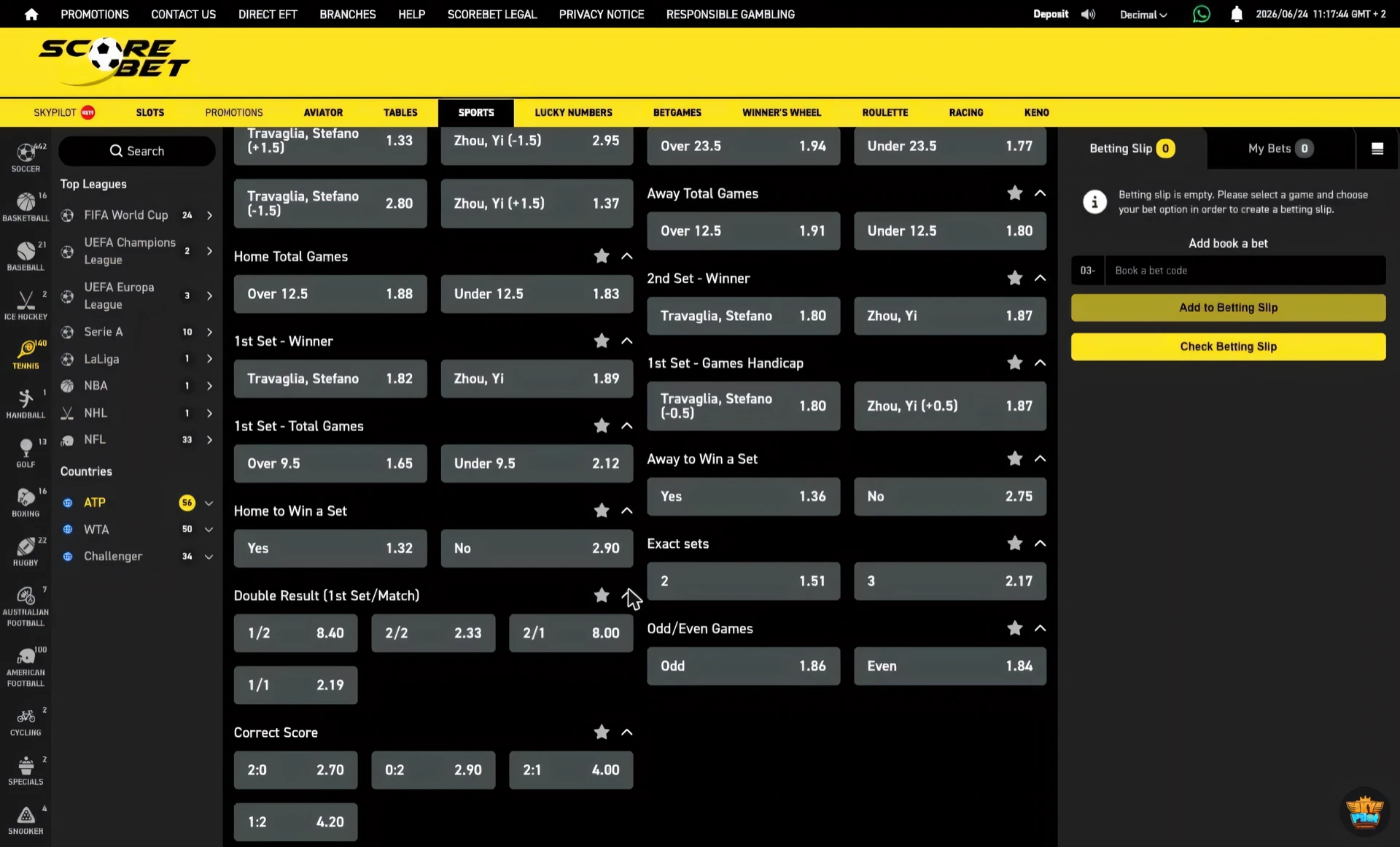
Double result stacks two questions into one bet: who wins the first set, and who wins the match. Scorebet writes it as a pair — 1/1, 1/2, 2/1, 2/2 — where the first figure is the set one winner and the second is the match winner. Get both right and you collect at a price well above the straight winner.
The four outcomes split into two kinds. 1/1 and 2/2 are the front-runner paths: the player who takes the opening set goes on to win, which is what usually happens, so they’re the short prices around 2.20–2.33. 2/1 and 1/2 are the comebacks — drop the first set, win the match — and because that’s the hardest road in tennis they pay up around 8.00–8.40. The market is essentially a set winner and a match winner welded together.
Use it when you have a strong read on the shape of the match, not just the result. A slow starter you trust to recover is the textbook 2/1 or 1/2 play. If you want to go one level finer and call the exact set tally, the correct score market pays even more for the extra precision.
Place it on Scorebet, step by step
- 1Open the match and the section
Open a tennis fixture and scroll to Double Result (1st Set/Match).
- 2Read the combinations
Pick from 1/1, 1/2, 2/1 or 2/2. The first figure is the 1st set winner, the second is the match winner.
- 3Choose your scenario
1/1 is Player 1 wins set one and the match. 2/1 is Player 2 takes set one but Player 1 wins — a comeback.
- 4Stake and place
Tap the odds, add it to your Betting Slip, set your stake, then tap Place a Bet.
Example: double result prices
| Selection | Odds | R50 returns | Means |
|---|---|---|---|
| 1/1 — Player 1 wins set one and match | 2.19 | R109.50 | Front-runner holds |
| 2/2 — Player 2 wins set one and match | 2.33 | R116.50 | Front-runner holds |
| 2/1 — Player 2 set one, Player 1 match | 8.00 | R400.00 | Player 1 comeback |
| 1/2 — Player 1 set one, Player 2 match | 8.40 | R420.00 | Player 2 comeback |
The 1/1 and 2/2 combinations are the expected outcomes — whoever takes the first set usually closes out the match, which is why they're the shortest prices.
The comeback combinations 2/1 and 1/2 pay big. Save them for a slow starter you trust to fight back, not as a blind long shot.
Frequently asked
What does 2/1 mean in tennis double result betting?
The first number is the 1st set winner, the second is the match winner. 2/1 means Player 2 wins set one but Player 1 wins the match — a comeback. 1/1 means Player 1 wins both the set and the match.
Why does double result pay more than the match winner?
You have to be right twice, on the first set and on the match, so the outcomes are harder to land. The comeback combinations 1/2 and 2/1 pay the most because dropping the first set and still winning is the least likely path.
Is a double result comeback bet better value than backing the match winner outright after they drop the first set?
It can be, because the comeback price is locked pre-match while the live match-winner price after a lost first set moves against you fast. If you genuinely rate a slow starter to recover, taking 2/1 or 1/2 before play captures the full comeback odds rather than chasing a shorter in-play number once the set is gone — but you forfeit the bet entirely if they actually win the opener.
Why is the first set the pivot point this market is built around?
Holding serve early and breaking once is often enough to take an opening set, and the player who wins it wins the match the clear majority of the time in best-of-three. That strong correlation is why the book pairs the first set with the match rather than any other set — it's the one with the most predictive weight, which is exactly why the front-runner combos sit short and the comebacks pay up.