

Top 20 Finish
A top 20 finish is the most forgiving of the golf placing markets. Your golfer simply has to land somewhere in the top twenty of the final standings, so even a player who never threatens the lead can pay out with a tidy, consistent four rounds. In a typical 156-player field, that’s roughly the top 13 percent — a target steady professionals hit regularly.
The trade-off is in the price. Because the bet lands so often, the odds are the shortest of the finish markets, frequently sitting below 2.00 even for capable mid-pack names. That makes it a poor fit for chasing a big payout, but a sound one for backing reliability, especially across a deep field where the cut and the weather thin out the contenders. If you want a tighter target and a longer price on the same player, step up to the top 10 finish; if you simply want a golfer to survive into the weekend, the make the cut market settles after 36 holes.
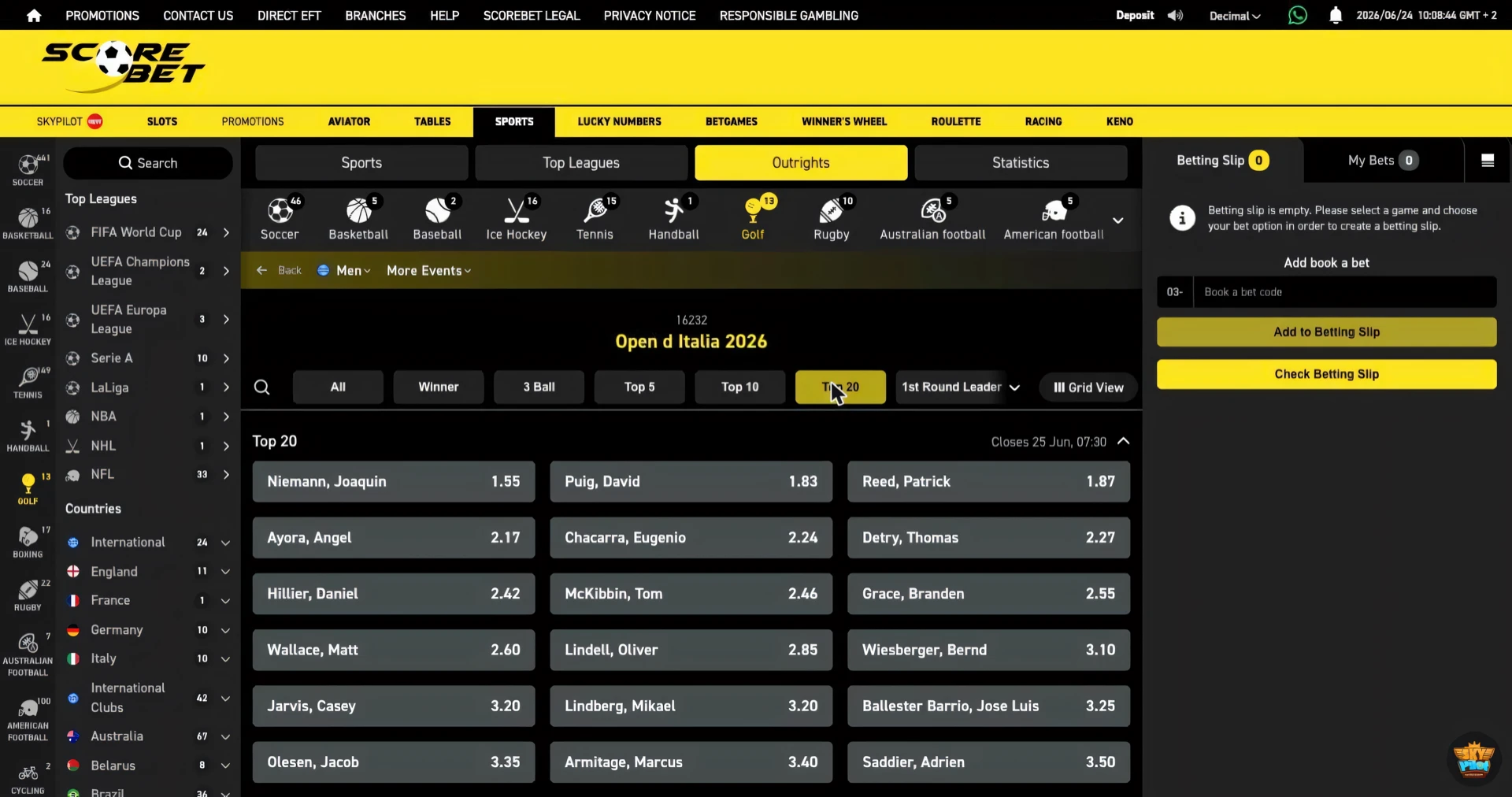
Place it on Scorebet, step by step
- 1Open the Top 20 tab
On the tournament page, tap the Top 20 tab to load the widest placing market.
- 2Read the prices
All competitors are listed with their top 20 odds. Even outside-chance players carry modest prices here, since nearly one in three of the field finishes inside the top twenty.
- 3Pick your golfer
Tap the odds beside the player you want and the selection drops into your slip.
- 4Stake and confirm
Enter your stake and confirm the bet.
Example: Open d Italia 2026 top 20
| Selection | Odds | R100 returns |
|---|---|---|
| Joaquin Niemann | 1.55 | R155 |
| David Puig | 1.83 | R183 |
| Patrick Reed | 1.87 | R187 |
| Angel Ayora | 2.17 | R217 |
Top 20 works well for solid mid-pack pros. In a 156-player field, top 20 means finishing in the top 13 percent, so steady players land it often.
Returns are smaller, so favourites rarely move the needle on their own. Stacking a couple of well-judged top 20 picks can build a return without the variance of an outright.
Frequently asked
Why are top 20 odds so short?
Because the target is so wide. In a 156-player field, finishing top 20 means landing in roughly the top 13 percent, so even capable mid-pack pros do it regularly. The shorter prices simply reflect how often the bet lands.
Is a top 20 finish a safe golf bet?
It is the most forgiving placing market, but no golf bet is safe — a missed cut or a single blow-up round can sink it. It suits steady performers in big fields, where the wide window does the work for you.
Why does a missed cut sink a top 20 bet even when the player was inside the top twenty at halfway?
A player who misses the cut doesn't get a final tournament position inside the top twenty — they're settled as a loser regardless of where they sat after 36 holes. The market pays on the final standings, not the leaderboard at any point during play. So a name who's top ten on Friday but slips below the cut line goes down as a losing top 20 bet, which is the hidden trap in this forgiving-looking market.
How does dead-heat settlement bite hardest at the top 20 line?
Because the top 20 is the widest finish market, ties straddling twentieth place are common — you'll regularly see four or five players bunched on the same score across positions 18 to 22. Anyone in that tie is treated as a top 20 finisher, but dead-heat rules cut the payout by the fraction of tied places that fall outside the line. With short odds already, that reduction can quietly turn a winning-looking bet into a near break-even one.