

To Make The Cut
A to make the cut bet is the cleanest call in golf: a straight Yes or No on whether your player survives the 36-hole cut. After two rounds, most tournaments send the bottom half of the field home, and this market simply asks which side of that line your golfer lands on. There are no placings to worry about and no four-day wait — it settles the moment the cut is confirmed.
The pricing leans heavily on form. A top name is usually a near-certainty to play the weekend, so Yes prices on the favourites sit around 1.21, leaving little to chase. The real interest is on the No side: an out-of-form star, a player struggling with their game, or a debutant at a brutal course can offer genuine value to miss the cut at a price near 4.00. For backing a player to go further than just surviving, the top 20 finish rewards a solid weekend, while the 72 hole match bet pits two named players head-to-head.
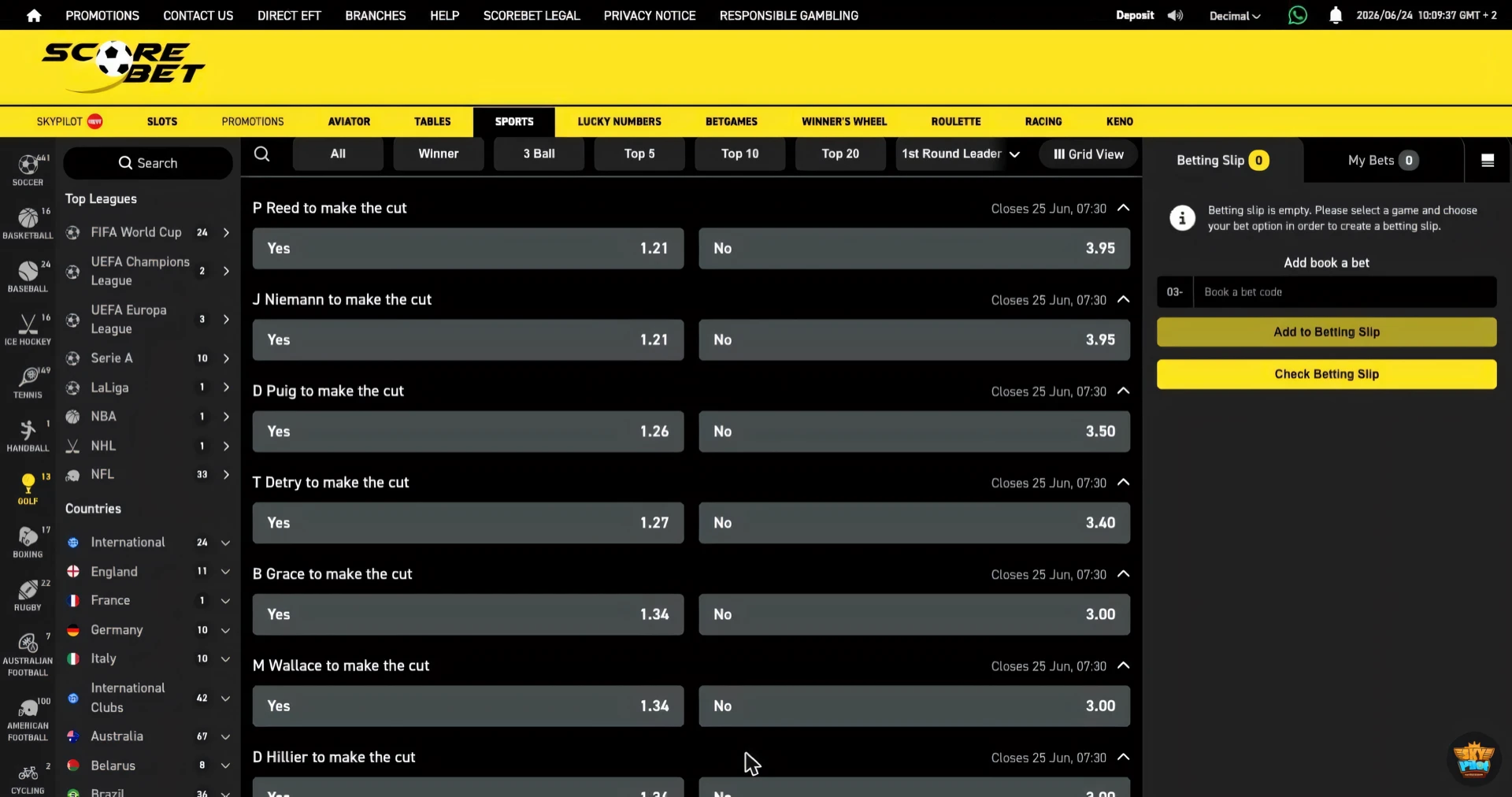
Place it on Scorebet, step by step
- 1Select To Make The Cut
Open the bet-type dropdown on the tournament page and choose To Make The Cut.
- 2Read the two prices
Each player is listed with a Yes (makes the cut) and a No (misses the cut). Yes prices around 1.20 to 1.30 mark the players very likely to survive.
- 3Pick a side
Decide whether your golfer makes it through or falls short, then tap the Yes or No odds to add it to your slip.
- 4Stake and confirm
Enter your stake and confirm the bet.
Example: Open d Italia 2026 to make the cut
| Selection | Odds | R100 returns |
|---|---|---|
| Patrick Reed — Yes | 1.21 | R121 |
| Patrick Reed — No | 3.95 | R395 |
| Joaquin Niemann — Yes | 1.21 | R121 |
| David Puig — No | 3.50 | R350 |
Betting No can offer value on a struggling or out-of-form player, especially an underdog making their first appearance at a tough, unfamiliar course.
Yes prices on the favourites are short for a reason. To get a return worth chasing, you usually need to find a fancied name in poor form and take the No.
Frequently asked
What is the cut in golf?
After two rounds (36 holes) most professional tournaments eliminate the bottom half of the field. Players who make the cut play the weekend; those who miss it go home. The cut line is the score that separates the two.
Why are Yes odds on the cut so short?
Because the best players in a field usually survive 36 holes comfortably. A favourite priced around 1.21 to make the cut reflects how rarely a top name fails to play the weekend, so the value often sits on the No side for an out-of-form pick.
Does the cut line move, and how does that affect a borderline player?
Yes — the cut isn't a fixed score, it's wherever the leading group (often the top 65 and ties, depending on the event) falls after 36 holes, so it floats with how the field scores. A soft, low-scoring week pushes the cut line lower and squeezes out a player who'd have survived on a harder week. That's why a borderline name's Yes price is really a bet on the conditions as much as on the golfer.
What is the rule of 65 and why does it sometimes change who makes the cut?
Many tours apply a secondary cut: if too many players make the standard 36-hole cut, a further trim takes the field back down toward a set number for the weekend. When a soft course leaves a big logjam at the cut line, that extra cull can send home players who technically beat the original line. A borderline Yes can lose to a rule most casual punters never see coming, so it's worth knowing the specific tournament's cut format.